Single or double quotation marks are two punctuation styles that often confuse writers, students, and English learners. Both marks are used to show direct speech, quotations, titles, special words, and certain writing situations, but their correct use depends on the style of English being followed.
Many people wonder whether single quotation marks or double quotation marks are the “right” choice. The answer is that both can be correct. The main difference comes from regional writing conventions, style guides, and the purpose of the quotation.
In this guide, you will learn the meaning of single and double quotation marks, when to use each one, the differences between American and British English, common mistakes, grammar rules, examples, and easy ways to remember the correct usage.
(Quick Answer) Single or Double Quotation Marks
Single quotation marks (‘ ’) and double quotation marks (“ ”) are both correct punctuation marks used to show quotations, speech, and special terms. American English usually prefers double quotation marks first, while British English often uses single quotation marks first. Both styles are acceptable when used consistently.
Comparison Table: Single or Double Quotation Marks
| Category | Double Quotation Marks (“ ”) | Single Quotation Marks (‘ ’) |
| Correct Form | “Example” | ‘Example’ |
| Meaning | Marks a direct quote, speech, or special expression | Marks a quote, often inside another quote or in British style |
| Definition | A pair of punctuation marks used to identify exact words spoken or written | A pair of punctuation marks used for quotations, emphasis, or nested quotations |
| Part of Speech | Punctuation mark | Punctuation mark |
| Grammar Rule | American English usually uses double quotation marks for main quotations | British English often uses single quotation marks for main quotations |
| Correct Usage | She said, “I am ready.” | She said, ‘I am ready.’ |
| Incorrect Usage | Mixing styles without reason | Changing styles randomly |
| Pronunciation | “Double quotation marks” | “Single quotation marks” |
| Common Mistake | Using double marks everywhere without following a style guide | Using single marks in American academic writing without checking requirements |
| Memory Tip | Double marks are the default in American English | Single marks are common in British English |
| Example | “Learning English takes practice.” | ‘Learning English takes practice.’ |
What Are Double Quotation Marks?
Double quotation marks (“ ”) are punctuation marks used to show exact words spoken by someone, direct quotations, and certain special expressions.
In American English, double quotation marks are the standard choice for most quotations. Newspapers, academic writing, business documents, and online content in the United States commonly use double quotation marks as the primary quotation style.
Definition of Double Quotation Marks
Double quotation marks are a pair of curved punctuation marks placed around words that are being quoted directly or highlighted for a specific purpose.
Examples of Double Quotation Marks
- Maria said, “I will finish the project tomorrow.”
- The teacher explained, “Practice improves writing skills.”
- The article titled “How to Improve Communication” became popular.
- Many people describe the movie as “a modern classic.”
Grammar Role of Double Quotation Marks
Quotation marks do not function as words in a sentence. They are punctuation symbols that help readers understand that certain words are being quoted, repeated, or discussed.
What Are Single Quotation Marks?
Single quotation marks (‘ ’) are punctuation marks that look like smaller quotation symbols. They are commonly used in British English and are also used in American English when placing a quotation inside another quotation.
Definition of Single Quotation Marks
Single quotation marks identify quoted material, especially a quotation within another quotation.
Examples of Single Quotation Marks
- The author wrote, “The character called ‘The Wanderer’ represents freedom.”
- She said, ‘I heard him say “hello” before leaving.’
- The word ‘success’ has different meanings for different people.
Grammar Role of Single Quotation Marks
Like double quotation marks, single quotation marks are punctuation marks. They do not change the grammatical function of the words inside them.
Key Differences Between Single and Double Quotation Marks
The biggest differences between single and double quotation marks are based on style preference and quotation levels.
Main Differences
- American English usually uses double quotation marks for primary quotations.
- British English often uses single quotation marks for primary quotations.
- Single quotation marks are commonly used inside double quotation marks in American writing.
- Double quotation marks are commonly used inside single quotation marks in British writing.
- Both styles are grammatically acceptable when used consistently.
Example in American English
“I heard Sarah say ‘thank you’ before she left,” John explained.
In this sentence:
- Double quotation marks show John’s exact words.
- Single quotation marks show Sarah’s words inside John’s quote.
Example in British English
‘John said, “I heard Sarah say thank you before she left,”’ explained Maria.
British writers may reverse the order depending on their chosen style.
Grammar Rules for Single and Double Quotation Marks
Understanding quotation mark rules helps writers avoid punctuation errors.
Rule 1: Use Quotation Marks for Direct Speech
Quotation marks show the exact words spoken by someone.
Examples:
- “Please close the door,” the manager said.
- “I enjoy reading,” Anna explained.
Do not use quotation marks when you are only summarizing someone’s idea.
Incorrect:
- The teacher said that “students should study regularly.”
Correct:
- The teacher said that students should study regularly.
- The teacher said, “Students should study regularly.”
Rule 2: Be Consistent With Your Style
A writer should choose one quotation style and follow it throughout the document.
Incorrect:
- “The book was called ‘A New Beginning’ and the author said, ‘It changed my life.’”
Correct American style:
- “The book was called ‘A New Beginning,’ and the author said, ‘It changed my life.’”
Rule 3: Use One Type Inside Another Quote
When a quotation appears inside another quotation, use the opposite quotation mark style.
American English:
- “The teacher said, ‘Always check your grammar,’ before the exam.”
British English:
- ‘The teacher said, “Always check your grammar,” before the exam.’
Rule 4: Use Quotation Marks for Certain Titles
Short works often use quotation marks.
Examples:
- “The Road Not Taken” by Robert Frost
- “A Brief History of Time” article
- “Yesterday” by The Beatles
Long works usually use italics instead:
- Books
- Movies
- Albums
- Newspapers
When to Use Single or Double Quotation Marks
Academic Writing
In American academic writing, double quotation marks are generally preferred for direct quotes.
Example:
- The researcher stated, “Language changes over time.”
However, students should always follow their institution’s style guide.
Professional Writing
Business documents usually follow American conventions and use double quotation marks.
Examples:
- The client described the service as “excellent.”
- The report included the phrase “customer satisfaction.”
Formal English
Formal writing requires consistency more than a specific quotation mark choice. Both styles can work if the writer follows an accepted standard.
Informal English
In everyday writing, people often choose whichever style matches their region or personal preference.
Examples:
- “That was amazing!”
- ‘That was amazing!’
Business Emails
Professional emails in American English usually use double quotation marks.
Example:
- The manager called the results “encouraging.”
Daily Conversation
In normal conversation, quotation marks are rarely discussed, but they appear when people write dialogue or repeat exact words.
Example:
- My friend said, “See you later.”
Common Mistakes With Quotation Marks
Mistake 1: Mixing Styles Randomly
Some writers switch between single and double quotation marks without a reason.
Incorrect:
- “The report was called ‘Final Results” and it was published yesterday.’
Correct:
- “The report was called ‘Final Results’ and it was published yesterday.”
Mistake 2: Using Quotation Marks for Emphasis
Quotation marks should not replace bold or italic formatting.
Incorrect:
- Our “best” product is available now.
This can suggest the word best is doubtful or sarcastic.
Better:
- Our best product is available now.
Mistake 3: Forgetting Nested Quotes
Writers sometimes use the same quotation mark style inside another quotation.
Incorrect:
- “She said, “I am ready,” before leaving.”
Correct:
- “She said, ‘I am ready,’ before leaving.”
Mistake 4: Incorrect Punctuation Placement
American English usually places commas and periods inside quotation marks.
Example:
Correct:
- She called the idea “interesting.”
Not:
- She called the idea “interesting”.
15 Original Examples of Single and Double Quotation Marks
- The professor said, “Clear writing requires careful organization.”
- My sister told me, “I finished reading ‘The Secret Garden’ last night.”
- The newspaper published an article called “The Future of Technology.”
- During the meeting, the director described the plan as “realistic.”
- The student wrote, “My favorite word is ‘curiosity’ because it inspires learning.”
- The coach shouted, “Remember the phrase ‘teamwork wins games.’”
- The novel included the sentence, “The character whispered, ‘I will return someday.’”
- The company announced a new policy titled “Workplace Improvement Program.”
- My friend said, “The restaurant’s special dish was ‘absolutely delicious.’”
- The author explained, “The word ‘hope’ appears throughout the story.”
- The news report called the discovery “a major scientific achievement.”
- The teacher asked, “Who can explain the meaning of ‘innovation’?”
- The website published a guide called “Simple Writing Rules.”
- The speaker said, “Many people misunderstand the word ‘confidence.’”
- The manager wrote, “The project reached its ‘final stage’ after months of work.”
- The article described the event as “one of the biggest moments of the year.”
- The student explained, “My essay focuses on ‘environmental responsibility.’”
- The author wrote, “Readers often connect with stories about ‘ordinary heroes.’”
Memory Trick: How to Remember the Difference Forever
Use this simple method:
American = Double first. British = Single first.
Think:
- American writers usually start with double quotation marks.
- British writers often start with single quotation marks.
For nested quotations:
- Double outside → Single inside.
- Single outside → Double inside.
The key is not choosing one as “better.” The key is choosing a style and staying consistent.
Mini Quiz: Test Your Knowledge
1. Which quotation style is most common in American English?
A. Single quotation marks
B. Double quotation marks
C. No quotation marks
D. Italics only
Answer: B. Double quotation marks
2. Which sentence is correct?
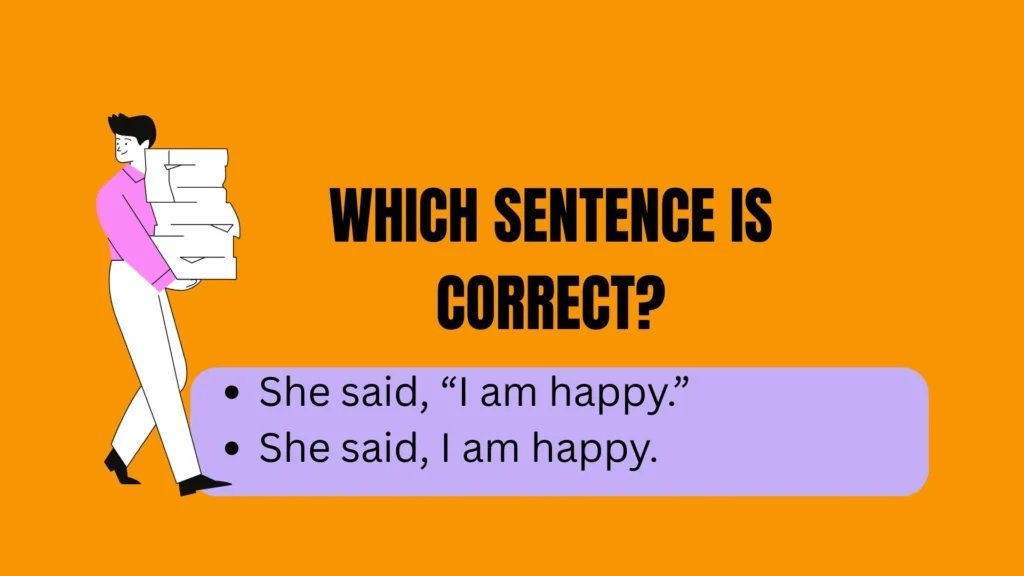
A. She said, “I am happy.”
B. She said, I am happy.
C. She said ‘I am happy”.
D. She said, “I am happy’.
Answer: A. She said, “I am happy.”
3. What should you use inside a double quotation in American English?
A. Another double quotation
B. Single quotation marks
C. Parentheses
D. Brackets only
Answer: B. Single quotation marks
4. Are single quotation marks always incorrect in American English?
A. Yes
B. No
C. Only in books
D. Only online
Answer: B. No
5. What is the most important quotation mark rule?
A. Always use single marks
B. Always use double marks
C. Be consistent with your chosen style
D. Avoid quotation marks
Answer: C. Be consistent with your chosen style
FAQs About Single or Double Quotation Marks
Are single or double quotation marks better?
Neither style is universally better. Both single and double quotation marks are correct. American English usually prefers double quotation marks, while British English often prefers single quotation marks. The most important rule is to follow a consistent style throughout your writing.
Should I use single or double quotation marks in American English?
American English generally uses double quotation marks for direct speech, quotations, and special terms. Single quotation marks are mainly used for a quotation inside another quotation. For example: “She said, ‘Hello,’ before leaving.”
Are single quotation marks wrong?
No, single quotation marks are not wrong. They are commonly used in British English and in specific situations in American English. The mistake happens when writers use them inconsistently or ignore the required style guide.
Do quotation marks go before or after punctuation?
In American English, commas and periods usually go inside quotation marks. Question marks and exclamation points depend on whether they belong to the quoted material or the entire sentence.
Can I use single quotation marks for emphasis?
Quotation marks can sometimes show special meaning, but they should not normally be used only for emphasis. Using quotation marks around ordinary words may make the meaning unclear or suggest sarcasm.
What is the difference between single and double quotation marks?
The main difference is style preference and usage position. Double quotation marks are the standard choice in American English, while single quotation marks are common in British English and nested quotations.
Key Takeaways
- Single and double quotation marks are both correct punctuation marks.
- American English usually prefers double quotation marks first.
- British English often prefers single quotation marks first.
- Use the opposite quotation style inside another quotation.
- Consistency matters more than choosing one style.
- Quotation marks should show quotations, not random emphasis.
- Always follow the required style guide for academic or professional writing.
Conclusion
Understanding single or double quotation marks becomes easier when you know the difference between regional styles and quotation levels. Double quotation marks are the standard choice in American English, while single quotation marks are common in British English and nested quotations. Both forms are correct when used properly and consistently. Good punctuation helps readers understand exactly which words are being quoted and improves the clarity of your writing.

I am Sophia Williams, an English writing expert who loves helping people discover the power of correct grammar and effective communication. I specialize in explaining grammar concepts, word differences, sentence improvement techniques, and everyday English usage in a friendly and practical way. I believe learning grammar should be interesting, accessible, and useful for real-life conversations and professional writing.
I have written educational books including “Perfect Your English: Grammar Tips for Better Writing” and “The Modern English Grammar Companion.” My work focuses on helping readers develop strong language skills and become more confident English users.